• Skip to main content
  • Skip to footer

Reggae In Seattle

Reggae In Seattle

  • Events
  • TV EPISODES
  • Artist Interviews
  • Blog
  • Contact Us

Birthday

BLESSED EARTH STRONG TO H.I.M. EMPEROR HAILE SELASSIE I

July 23, 2025 By Roland Lundberg

Today on July 23, Rastafarians around the world rejoice in the birthday celebrations of Ethiopia’s EMPEROR HAILE SELASSIE I. Born as Ras Tafari Makonnen in 1892, he served as Ethiopia’s Regent from 1916 to 1930 and as Emperor from 1930 to 1974.

Haile Selassie | The Last Ethiopian Emperor And Rastafarianism | HistoryExtra

Years prior to Haile Selassie’s enthronement, American black-nationalist leader Marcus Garvey began preaching of a coming messiah who would lead the peoples of Africa, and the African diaspora, into freedom. When news of Selassie’s coronation reached Jamaica, it became evident to some that Selassie was this foretold of messiah. Beyond the prophesies in the book of Revelation and New Testament that Rastafari point to as proof of Selassie’s status, the emperor also could trace his lineage back to King Solomon and the Queen of Sheba. Rastafari pointed to Selassie as the Conquering Lion of the Tribe of Judah, the Root of David and the King of Kings.

Childhood - Rasta Ites

Tafari was a great-grandson of Sahle Selassie of Shewa (Shoa) and a son of Ras (Prince) Makonnen, a chief adviser to Emperor Menilek II. Educated at home by French missionaries, Tafari at an early age favorably impressed the emperor with his intellectual abilities and was promoted accordingly. As governor of Sidamo and then of Harer province, he followed progressive policies, seeking to break the feudal power of the local nobility by increasing the authority of the central government. He thereby came to represent politically progressive elements of the population. In 1911 he married Wayzaro Menen, a great-granddaughter of Menilek II.

When Menilek II died in 1913, his grandson Lij Yasu succeeded to the throne, but the latter’s unreliability and his close association with Islam made him unpopular with the majority Christian population of Ethiopia. Tafari became the rallying point of the Christian resistance, and he deposed Lij Yasu in 1916. Zauditu, Menilek II’s daughter, thereupon became empress in 1917, and Ras Tafari was named regent and heir apparent to the throne.

While Zauditu was conservative in outlook, Ras Tafari was progressive and became the focus of the aspisrations of the modernist younger generation. In 1923 he had a conspicuous success in the admission of Ethiopia to the League of Nations. In the following year he visited Rome, Paris, and London, becoming the first Ethiopian ruler ever to go abroad. In 1928 he assumed the title of negus (“king”), and two years later, when Zauditu died, he was crowned emperor (November 2, 1930) and took the name of Haile Selassie (“Might of the Trinity”). In 1931 he promulgated a new constitution, which strictly limited the powers of Parliament. From the late 1920s on, Haile Selassie in effect was the Ethiopian government, and, by establishing provincial schools, strengthening the police forces, and progressively outlawing feudal taxation, he sought to both help his people and increase the authority of the central government.

When Italy invaded Ethiopia in 1935, Haile Selassie led the resistance, but in May 1936 he was forced into exile. He appealed for help from the League of Nations in a memorable speech that he delivered to that body in Geneva on June 30, 1936. With the advent of World War II, he secured British assistance in forming an army of Ethiopian exiles in the Sudan. British and Ethiopian forces invaded Ethiopia in January 1941 and recaptured Addis Ababa several months later. Although he was reinstated as emperor, Haile Selassie had to recreate the authority he had previously exercised. He again implemented social, economic, and educational reforms in an attempt to modernize Ethiopian government and society on a slow and gradual basis.

The Ethiopian government continued to be largely the expression of Haile Selassie’s personal authority. In 1955 he granted a new constitution giving him as much power as the previous one. Overt opposition to his rule surfaced in December 1960, when a dissident wing of the army secured control of Addis Ababa and was dislodged only after a sharp engagement with loyalist elements.
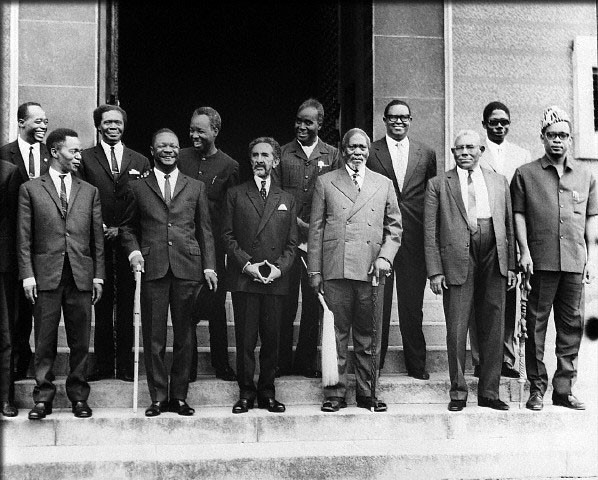
The Organisation of African Unity: a Symbol for Pan-Africanism? – IRM

Haile Selassie played a very important role in the establishment of the Organization of African Unity in 1963. His rule in Ethiopia continued until 1974, at which time famine, worsening unemployment, and the political stagnation of his government prompted segments of the army to mutiny. They deposed Haile Selassie and established a provisional military government that espoused Marxist ideologies. Haile Selassie was kept under house arrest in his own palace, where he spent the remainder of his life. Official sources at the time attributed his death to natural causes, but evidence later emerged suggesting that he had been strangled on the orders of the military government.

Selassie remained a lifelong Christian, but never reproached the Rastafari for their beliefs in him as the returned Messiah.


Filed Under: Africa, Anniversary, Culture, Ethiopia, Haile Selassie, History, Jamaica, Marcus Garvey, Rastafari Tagged With: Birthday, Ethiopia, Haile Sealssie, Ras Tafari

BLESSED EARTH STRONG TO JUDY MOWATT

December 23, 2024 By Roland Lundberg

Image result for judy mowatt"

Judith Veronica Mowatt was born 23 Dec 1952 in Gordon Town, Jamaica. At the age of 13, she became a member of a dance troupe which toured Jamaica and other islands in the Caribbean. Her initial ambition was to become a registered nurse. Her earliest musical influences were Aretha Franklin, Otis Redding, Curtis Mayfield, Dionne Warwick, The Staple Singers and The Soulettes. A coincidental meeting with two teenage girls who were earlier in her dance troupe led to the formation of the Gaylettes, in 1967.

Her solo recordings, including Black Woman in 1980 and Only a Woman, two years later, marked her as a powerful spokesperson for Rastafarian and feminist causes. Mowatt initially attracted attention as lead singer of a vocal trio, the Gaylettes, also known as the Gaytones, that she formed with Beryl Lawrence and Merle Clemonson in 1967. Based on such Motown groups as the Supremes, the Marvelettes, and Gladys Knight & the Pips, the Gaylettes harmonized on a rich mix of R&B and Jamaican dance music.

The trio remained together until 1970 when Lawrence and Clemonson immigrated to the United States and Mowatt embarked on a solo career, recording under a series of pseudonyms including “Juliann.” Mowatt’s greatest break came when vocalist Marcia Griffiths asked her to sing harmony on a track that she was recording at Studio One with her duo partner Bob Andy in 1974. Rita Marley, the wife of Bob Marley and the mother of Ziggy Marley, was also hired to sing on the tune. The three woman hit it off so well that Griffiths invited Mowatt and Marley to sing the Supremes tune “Remember Me” with her when she performed that night at the House of Chen in New Kingston. The appearance was so successful that they agreed to continue performing together as the I-Threes.

Around the same time, Bob Marley was beginning to rebound from his split with Peter Tosh and Bunny “Wailer” Livingston. During a visit to the home of reggae producer Lee Perry in Cardiff Crescent in the Washington Gardens section of Jamaica, it was suggested that Marley incorporate the I-Threes into his performances. After singing harmony on Marley’s song “Jah Live” and on an album, Natty Dread, the I-Threes performed their first concert with him as the opening act for the Jackson 5 in spring 1975. The I-Threes continued to work with Marley until his death in May 1981. Five years later, Mowatt and the I-Threes toured in a package show that featured musicians from Marley’s band the Wailers and introduced Ziggy Marley & the Melody Makers to North American audiences.

A member of the Rastafarian group the Twelve Tribes of Israel, Mowatt recalled her fascination with Marley during an interview: “I had gotten to realize in reading my Bible that this man (Marley) was really Joseph in his second advent. I saw in the man that this time he came not only with the physical corn to feed his people but he came with the spiritual corn, which was the message that transcended to the four corners of the world.”

In addition to her work with Marley and the I-Threes, Mowatt continued to pursue a solo career. Her album, Black Woman, released in 1977, was the first to be recorded at Marley’s Tuff Gong studios.


Filed Under: Artist, Birthday, Reggae Tagged With: Birthday, Bob Marley, Judy Mowatt, Reggae

BLESSED EARTH STRONG TO NAT TURNER

October 2, 2022 By Roland Lundberg

Nat Turner
Nat Turner (October 2, 1800 – November 11, 1831)
 
Nat Turner was an enslaved African-American preacher who led a two-day rebellion of both enslaved and free black people in Southampton County, Virginia, beginning August 21, 1831. The rebellion caused the death of approximately 60 white men, women and children. Whites organized militias and called out regular troops to suppress the uprising. In addition, white militias and mobs attacked blacks in the area, killing an estimated 120, many of whom were not involved in the revolt.
 
The rebels went from plantation to plantation, gathering horses and guns, freeing and recruiting others along the way. During the rebellion, Virginia legislators targeted free blacks with a colonization bill, which allocated new funding to remove them, and a police bill that denied free blacks trials by jury and made any free blacks convicted of a crime subject to sale into slavery and relocation.
 
In the aftermath, the state tried those accused of being part of Turner’s slave rebellion: 18 were executed, 14 were transported out of state, and several were acquitted. Turner hid successfully for two months. When found, he was tried, convicted, sentenced to death, hanged and possibly beheaded. Across Virginia and other southern states, state legislators passed new laws to control slaves and free blacks. They prohibited education of slaves and free blacks, restricted rights of assembly for free blacks, withdrew their right to bear arms (in some states), and to vote (in North Carolina, for instance), and required white ministers to be present at all black worship services.

Filed Under: Birthday, History, US Tagged With: Birthday, History, Nat Turner

Footer

Stay Up To Date! Sign Up!

  • Events
  • TV EPISODES
  • Artist Interviews
  • Blog
  • Contact Us

Copyright © 2026 · Reggae In Seattle