• Skip to main content
  • Skip to footer

Reggae In Seattle

Reggae In Seattle

  • Events
  • TV EPISODES
  • Artist Interviews
  • Blog
  • Contact Us

Reggae In Seattle

BLESSED EARTH STRONG TO JOE HIGGS

June 3, 2026 By Roland Lundberg

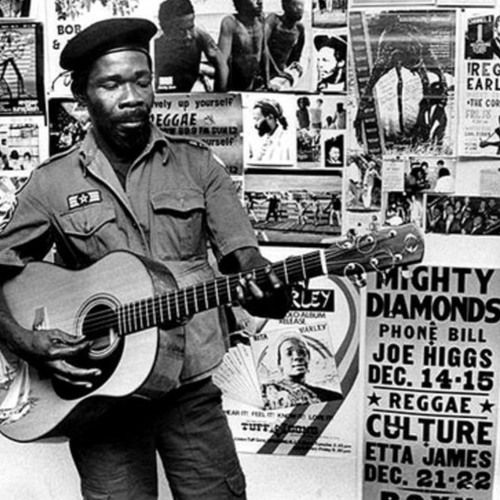
Joseph Benjamin “Joe” Higgs was born 03 June, 1940 in Kingston and was instrumental in the foundation of modern Jamaican music, first recording in 1958 for producer and businessman (and later Jamaican Prime Minister) Edward Seaga, both as a solo artist and with Roy Wilson. He is often called the “Godfather of Reggae”.

His first release (with Wilson) was “Oh Manny Oh” in 1958, which was one of the first records to be pressed in Jamaica and went on to sell 50,000 copies. Higgs and Wilson also recorded for Clement “Coxsone” Dodd in the late 1950s and early 1960s. The partnership with Wilson dissolved in 1964 when Wilson emigrated to the United States. Higgs then concentrated on a solo career and also worked with Carlos Malcolm and the Afro-Jamaican Rhythms, before joining Lynn Taitt’s The Soul Brothers as lead vocalist.

BOB MARLEY talking with friend, mentor and music teacher JOE HIGGS... | Bob marley, Bob marley legend, Marley

Higgs mentored young singers in his yard and began working with Bob Marley in 1959. In fact, it was at one of the informal music lessons Joe Higgs held in Trench Town, that Bob and Bunny Livingston met Peter Tosh. Marley acknowledged later on that Higgs had been an influential figure for him, while Higgs described their time together: “I am the one who taught the Wailers the craft, who taught them certain voice technique”. It was Higgs who introduced the Wailers to Dodd in 1963.

Higgs has also been described as the “Father of Reggae” by Jimmy Cliff. For a while Higgs toured with Cliff, acting as his bandleader as well as writing songs for Cliff including “Dear Mother”, and also performed with The Wailers on their US tour when Bunny Wailer refused to go on the tour in 1973.

Higgs won the Jamaican Tourist Board Song Competition in 1972 with “Invitation to Jamaica”, released as a single on his own Elevation label, and much of his best-known solo work was issued in the 1970s. Singles included “More Slavery” (released on Micron), “Creation” (Ethnic Fight), “Let Us Do Something” (Elevation), and “World Is Upside Down” (Island). His debut album, Life of Contradiction, had been recorded in 1972 for Island Records, but as Island boss Chris Blackwell felt that it would be difficult to market it remained unreleased until 1975, when it was issued by Micron Music, and has been described as “a seminally sophisticated work combining reggae, jazz, and rhythm and blues influences to create a new texture that would have a profound effect on the best Jamaican music to follow”.

As well as The Wailers, Higgs also helped several other singers and groups including The Wailing Souls. His second album, Unity Is Power, was released in 1979 and further singles followed on Cliff’s Sunpower label and Bunny Wailer’s Solominic imprint.

His 1983 single “So It Go”, with a lyric critical of the Jamaican government of the day was banned from airplay and led to harassment which would eventually lead to Higgs relocating to Los Angeles, where he lived for the rest of his life.
Joe Higgs Tribute - Let us do something (Recut) by SAJ MOOR DUB

Two further albums were released in the 1980s, Triumph (1985) and Family (1988), and in 1990 he recorded Blackman Know Yourself on which he was backed by the Wailers Band, and includes covers of the Marley/Lee Perry songs “Small Axe” and “Sun Is Shining”. In 1995, his final album was issued, Joe and Marcia Together, a collaboration with his daughter.

A majority of Higgs’ songs were connected to his impoverished life in Trenchtown where he grew up. Higgs considered that it was out of the poverty and violence of Kingston’s shantytowns such as Trenchtown and Johnstown that the reggae music had grown. Before reggae hit big on the western music scene with Bob Marley, it was understood as a “ghetto music”. Higgs was the very first artist out the ghetto music scene to have lyrics which primarily dealt with every day troubles. In his own words:
“Music is a matter of struggle. It’s not good that it’s known you’re from Trenchtown. Reggae is a confrontation of sound. Reggae has to have that basic vibrant sound that is to be heard in the ghetto. It’s like playing the drum and bass very loud. Those are the basic sounds. A classical reggae should be accepted in any part of the world. Freedom, that’s what it’s asking for; acceptance, that’s what it needs, and understanding, that’s what reggae’s saying. You have a certain love come from hard struggle, long suffering. Through pain you guard yourself with that hope of freedom, not to give up…”

He died of cancer on 18 December 1999 at Kaiser Hospital in Los Angeles.

Filed Under: Artist, Earth Strong, History, Jamaica, Reggae, Rocksteady, Roots Tagged With: Blessed Earth Strong, Joe Higgs, Reggae In Seattle

MARCH 23, 1978 – KAYA RELEASED

March 23, 2026 By Roland Lundberg

Kaya is the tenth studio album released by Bob Marley and the Wailers. Exodus was still on the UK chart when its follow-up Kaya was released on 23 March, 1978. This was a testament not only to Bob Marley’s phenomenal popularity at this point but also to the man’s impressive work ethic and his ability to shrug off the worsening health problem with Acral Melanoma, a malignant skin cancer. The album was recorded concurrently with the tracks released on the Exodus album in 1977.

The album did not have the usual lyrical and musical militancy, and received some critique for ‘going soft’ as the songs primarily revolved around love and marijuana. Marley retorted:

“I was in the camp and there was no war.”

The album’s release coincided with the One Love Peace Concert and Marley’s triumphant return to Jamaica from his self-imposed exodus in London following the assassination attempt in December of 1976 at his Kingston homestead. Kaya reached the top five in the UK album charts.

While in London, Marley was arrested and charged with possession of cannabis. He appeared at Marylebone Magistrates Court on 4 June 1977 where he was found guilty and fined £50. Kaya was an eloquent riposte to the UK law enforcement agencies, whose sanctions had clearly not discouraged Marley from smoking herb.

The album was recorded with The Wailers that comprised brothers Carlton and Aston “Family Man” Barrett on drums and bass, Tyrone Downie on keyboards, Alvin “Seeco” Patterson on percussion, and the I Threes — Rita Marley, Marcia Griffiths, and Judy Mowatt , along with newest member Julian (Junior) Marvin on guitar.

Two of Kaya’s songs had previously appeared in different arrangements on 1971’s Soul Revolution: “Kaya” and “Sun Is Shining”.

Songs:
– Easy Skanking
– Kaya
– Is This Love
– Sun Is Shining
– Satisfy My Soul
– She’s Gone
– Misty Morning
– Crises
– Running Away
– Time Will Tell


Filed Under: Anniversary, Artist, Bob Marley, Jamaica, Reggae, Roots Tagged With: Bob Marley, Kaya, Reggae In Seattle, The Wailers

03 DEC 1976 – BOB MARLEY ASSASSINATION ATTEMPT

December 3, 2025 By Roland Lundberg

In 1976, Jamaican was reeling from political violence during the election. The supporters of the Jamaican Labor Party JLP and the People National Party PNP were clashing in the streets of Kingston resembling a war zone. Food supplies were running short, loss of power were common place and weapons had flooded the island and no-go areas had been established.

The CIA backed the JLP and the PNP drew support from Cuba and Russia. Both parties wanted the support of Bob Marley and the artistic gravitas he carried. Bob wanted to remain neutral and non-political and had arranged the Smile Jamaica concert to bring the island together. However, the incumbent PNP moved the election date to coincide with the concert, thus trying to make it into a rally for the government. This drew the ire of Bob and he was forced to have a plain-clothed police detail was stationed outside the house on Hope Road as danger was ever present. Bob was not to be deterred and pressed on with the preparations for the concert. On December 03 he had a rehearsal with The Wailers working on the set list.

As Rita Marley left the house in her Volkswagen, she stopped to let another vehicle enter the compound through the gate that had been left unmanned. Gunshots rang out from the entering car and the bullet glanced across Rita’s scalp. The two gunmen made their way to the galley kitchen where they they opened fire with two automatic weapons. The band and family members threw themselves out of the line of fire; some managed to escape the building, other were tangled in leads but scrambled their way to the safety of the bathroom as bullets tore drummer Carly Barrett’s stool apart.

As they fired on Bob, he turned to make himself a smaller target and at the same time his manager Don Taylor walked into the kitchen and the fire-line and absorbed most of the shots. One bullet grazed Bob’s chest and lodged itself in his arm where it stayed until his death in 1981. The doctors told him that were he to have it removed, it might damage the use of his fingers.

d

Neville Garrick speaks of the night of the assassination attempt.

Only Don Taylor was seriously injured before the gunmen sped off in the direction of the JLP headquarters in Tivoli Gardens. Two days later Bob, despite his injuries, stepped onto stage for the Smile Jamaica Concert at National Heroes Park in Kingston. He had agreed to perform one song for the 80,000 people in attendance, but it turned into a whole 90-minute performance.

In 2018, Netflix released ReMastered: Who Shot the Sheriff detailing the events of the assassination attempt on Bob.


Filed Under: Anniversary, Artist, Bob Marley, History, Jamaica Tagged With: Assassination Attempt, Bob Marley, Reggae In Seattle

BLESSED EARTH STRONG TO EVERTON BLENDER

November 21, 2025 By Roland Lundberg

Everton Dennis Williams Aka “Everton Blender” was born on November 21st, 1954 in Clarendon parish but grew up in Kingston. His singing career began in an amateur talent contest in the late 1970s at Kingston’s Bohemia Club where he sang Dennis Brown songs under the name “Babbaru”. He won the contest at the second attempt. He performed with the Destiny Outernational, Master Voice and Santex sound systems, and released several singles, including “Where Is Love” in 1979 and “Ba Ba Black Sheep” in 1985. He failed to achieve commercial success, however, and he withdrew from the music business, returning to his trade as a house painter.

Blender returned to music in the early 1990s when Garnett Silk, who had also worked with Destiny, introduced him to record producer Richard Bell, who signed him to his Star Trail label. This time around, Blender achieved success straight away, with “We No Jus’ a Come,” becoming a hit in Jamaica. Blender’s success spread to the United Kingdom where his first album, Lift Up Your Head, reached number four on the Black Echoes music chart. The title track from the album was nominated for a Jamaican Music Award. Further albums and singles followed, with his early singles from the second phase of his career collected on the album A Piece of da Blender: The Singles, released in 1996.

Blender was one of the most prominent singers in the 1990s return to ‘cultural’ reggae, along with the likes of Garnett Silk and Luciano.

He has released several albums on Heartbeat Records and also set up his own Blend Dem Productions label, working with artists such as Prezident Brown, Admiral Tibet, Louie Culture, Jah Mason, Spanner Banner, Richie Spice, and Anthony B, as well as producing his own recordings.

Blender once described his songwriting process: “Well we just meditate, and a vibe just come to us, or we just sit in and bring tune from scratch without melodies or anything, and melodies come to you later”. Blender has rejected the slack lyrics that have become common in reggae, stating “If the people tell you that them want rubbish, you know say them nuff fi get rubbish. Them fi get good things fi keep them internal and external clean. Never to fail, always righteousness. That’s what we’re working for”.


Filed Under: Anniversary, Artist, Birth Strong, Jamaica Tagged With: Blessed Earth Strong, Everton Blender, Reggae In Seattle

BLESSED EARTH STRONG TO ANTHONY B

March 31, 2025 By Roland Lundberg

Keith Blair aka “Anthony B” was born 31 March 1976 in Trelawny, Jamaica. His deeply religious family life (his mother was a Seventh-day Adventist and his grandmother a Revivalist) imbued him with a profound spirituality. During his youth, his favorite singers were reggae legends Bob Marley and Peter Tosh, musicians who strongly influenced his own style. Peter Tosh’s influence can definitely be heard in Anthony B’s vocal delivery and revolutionary stance.

Anthony B adopted Rastafari movement beliefs as a teenager and joined the mansion of Bobo Ashanti, a decision which was not well received by his family. The stubborn and determined Anthony B refused to give up his new religion and his dreadlocks and moved to the home of his aunt and uncle in the Kingston suburb, Portmore.

While attending high school, Anthony B debuted as a deejay for the local sound system, Shaggy Hi-Power. In 1988, he befriended reggae artists such as Determine, Mega Banton, Ricky General and Terror Fabulous. At this point in the reggae industry, singing “slack” songs about women was the popular thing to do. Anthony B did not believe in degrading women and chose to pen politically slanted songs instead. He collaborated with Little Devon and made his debut single “The Living is Hard” on the Wizard label in 1993. Anthony B tried many different producers before joining with Richard Bell, creating hits such as “Fire Pon Rome”, “Raid Di Barn”, “Rumor”, and “Repentance Time”.

In late 1997, Anthony B released Universal Struggle, followed by a large number of albums since including 1999’s Seven Seals, 2003’s Street Knowledge, 2004’s Untouchable which featured collaborations with artists including Wyclef Jean, Snoop Dogg & Bone Crusher, 2005’s Black Star plus My Hope, and more recently, Life Over Death (2008).

In January 2013, he was charged with possession of marijuana with intent to distribute after being stopped in Georgia, United States due to illegally tinted windows in the vehicle in which he was travelling. He subsequently had to cancel several shows in South America as he was not allowed to travel outside the US.

In July 2013 he released Tribute to Legends, an album of cover versions of songs by artists such as Bob Marley, The Maytals, John Lennon, Ray Charles, Elvis Presley, and Ini Kamoze. Speaking of the album, he stated “I chose to make a tribute album to firstly show how much these legends influence my music and my life.”

Anthony B tours extensively with Jason Sese in Europe and North America. He has collaborated with singer-songwriter and producer Emmanuel Anebsa, who we featured on Reggae In Seattle in our “Featured Artist” segment.

Talking of his faith and music, Anthony B commented, “When we say ‘burn fire’ we don’t mean take a match and light somebody, we are saying get rid of these things that are no good for humanity.”

In 2016, Anthony B release a new album, Tears Of Luv on his label Born Fire Music and collaborate with various producer around the world including Evidence Music on his track Life Good.

In May 2020, Anthony B released his 20th studio album titled “King In My Castle”.

Filed Under: Birth Strong, Earth Strong, Jamaica, Reggae Tagged With: Anthony B, Blessed Earth Strong, Reggae In Seattle

  • Go to page 1
  • Go to page 2
  • Go to page 3
  • Interim pages omitted …
  • Go to page 15
  • Go to Next Page »

Footer

Stay Up To Date! Sign Up!

  • Events
  • TV EPISODES
  • Artist Interviews
  • Blog
  • Contact Us

Copyright © 2026 · Reggae In Seattle